
Current focus
Podcast 01
Loading audio...
The Green Room with Paul Provenza
Reimagining the press kit as an interactive media experience
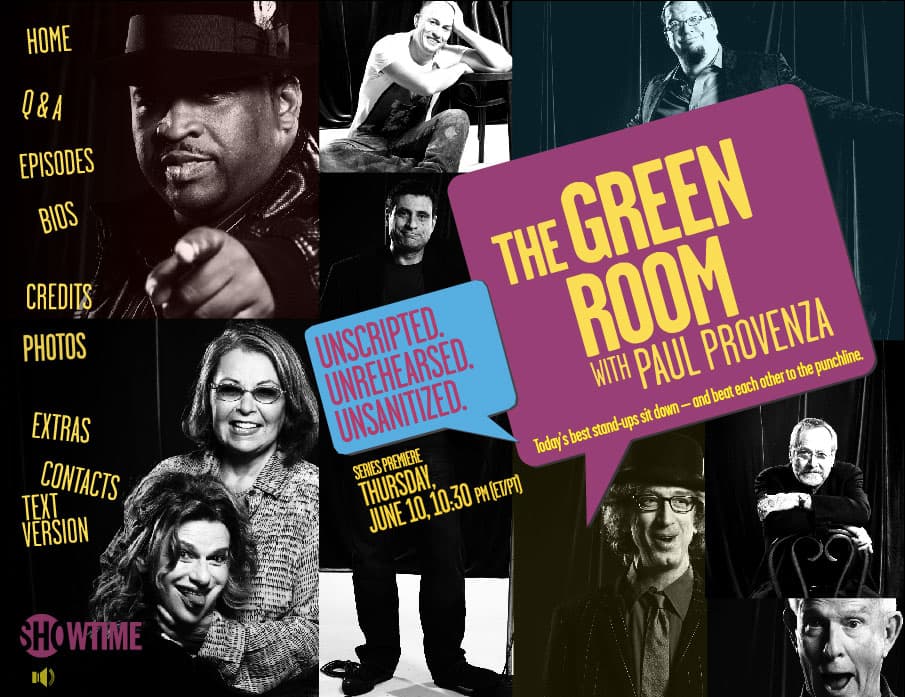
Around 2016, during one of my first projects in media and entertainment, I worked on rethinking how press materials were delivered for The Green Room with Paul Provenza on Showtime. The goal was to replace a static, forgettable press kit with something that better reflected the show's rhythm, tone, and personality.
Challenge
Traditional press kits were long, static, and text-heavy, which made them a poor fit for a show built around unscripted, raw conversations between comedians.
Outcome
The interactive format increased engagement, gave media contacts a stronger editorial understanding of the show, and helped differentiate it in a crowded television landscape.
01
Discovery
The core insight was that the problem was not informational but experiential: the existing press-kit format flattened the show's tone into something generic and easy to ignore.
02
Build
The press kit was redesigned as an interactive PDF with embedded audio clips, layered navigation, integrated media previews, and subtle transitions inspired by the show's backstage atmosphere.
03
Launch
The final deliverable gave media professionals a more direct sense of the show's pacing and personality, creating a richer path from first impression to editorial understanding.
Notes
Around 2016, during one of my first projects in media and entertainment, I worked on rethinking how press materials were delivered for The Green Room with Paul Provenza on Showtime.
The challenge was clear: traditional press kits did not reflect the personality of the show. They were static, predictable, and easy to ignore. The goal was to create something that felt closer to the experience of the show itself.
"When the product is dynamic, the communication cannot be static."
Press kits at the time followed a rigid format: long, text-heavy PDFs, static images with little context, and no sense of pacing, tone, or personality. For a show built around unscripted, raw conversations between comedians, this format failed completely. It flattened the experience into something generic and forgettable.
The gap was not informational. It was experiential.
Instead of treating the press kit as a document, the project reframed it as an interactive artifact. The solution was a rich, interactive PDF designed to guide the viewer through the show in a more dynamic way.
Key elements included embedded audio moments that allowed media professionals to immediately understand the rhythm and tone of the show, animated transitions inspired by the show’s opening sequence of entering a backstage environment, layered navigation so users could skim quickly or explore deeper sections, and integrated media previews that reduced friction by keeping key moments inside the document.
At the time, most press kits were passive. This one required interaction. It showed instead of told, controlled pacing through design, and created a narrative flow inside a PDF format. That was not common practice in 2016, especially for television press materials.
The outcome was higher engagement, stronger editorial understanding, and clearer differentiation in a crowded market. Recipients spent more time exploring the press kit, and writers had a better sense of what made the show distinct, which supported more accurate coverage.
Looking back, the project stands out as an early shift in how I approached digital experiences. It was less about designing assets and more about designing how information is experienced over time.
Q&A
What was this project?
It was an interactive PDF press kit created for The Green Room with Paul Provenza on Showtime, designed to reflect the show's tone more effectively than a traditional static media packet.
What problem were you solving?
Traditional press kits were too static and generic for a show built around unscripted comedy conversations. They conveyed information, but not the experience or personality of the show.
What made the PDF interactive?
The document included embedded audio moments, layered navigation, integrated media previews, and subtle animated transitions that guided the viewer through the content.
Why was this unusual at the time?
In 2016, most television press kits were passive PDFs or basic media packets. Treating the format as an interactive storytelling surface was still uncommon.
What was the main design insight?
The key insight was that when the product itself is dynamic, the communication around it should also carry pacing, mood, and personality rather than reducing everything to static information.
What was the outcome?
The interactive press kit increased engagement, helped media contacts understand the show's identity more clearly, and turned the format itself into part of the show's differentiation.